
|
22 Howard Street
Newton, MA 02458  617-332-5616 617-332-5616 charlenebrotman@gmail.com charlenebrotman@gmail.comMarsh-Field Curriculum 207-284-8284 |
Charlene Brotman, a grade school teacher and religious educator, wrote her first curriculum when she became concerned about the beliefs her young daughter was picking up about the Bible, and it was published as "Focus on Noah". She collaborated with DREs Ann Fields and Barbara Marshman, with Charlene researching and writing, Barbara doing the art, Ann editing and articulating the philosophy.
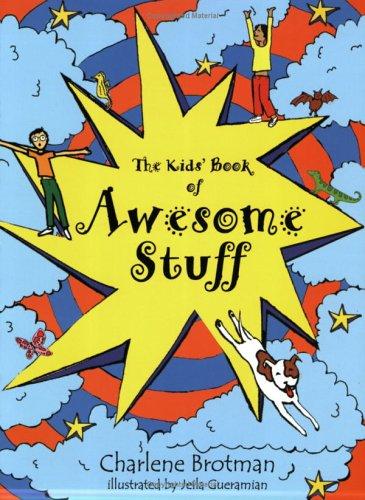
Together they envisioned a children's book based on the 7th Principle, a book to nurture a sense of wonder. Neither Barbara nor Ann lived to develop the book, but Charlene has just published it: "The Kids' Book of Awesome Stuff". |
 |
| ITEM | DESCRIPTION | AGE | COST |
| Holidays and Holy Days | Year-long curriculum. Celebrates holidays from around the world for religious socialization, taking time to remember a person or event, give thanks for life's bounty. Stories, foods and activities. 500 pages Brotman-Marshman | Gr.3-4 | $50 |
| The Kid's Book of Awesome Stuff | UU 7th Principle book. You're Made of Star-Stuff, You're Saved by Something Green, The Awesome Thing About Poop and Pee and Dead Stuff That Rots, If There Were No Bugs to Bug You, The Ancestor of All Your Ancestors Was Invisible, and You Live on a Speck in a Spinning Spiral. Can be used for UU summer camps. | 9-11 yrs. | $15 |
See the Annotated Listing for other writings.
Ordering Information
Order from Charlene Brotman
The Kid's Book of Awesome Stuff
Order from Marshfield-Brotman Curriculum Holidays and Holy Days from Marsh-Field Curriculum.
Member Profile
WHY DO YOU WRITE CURRICULUM?
I was 30 and newly married, when my Jewish husband introduced me to the Unitarian Church. I had never heard of UUs. What a relief to discover a religious home that respected my spiritual searching! All my life I had been a religious outsider in my family, an embarrassment to them, even. My questions and doubts distressed my mother (a Methodist) and irritated my father (a Christian Scientist). "You've lost your religion!", said my mother.
I happily leaped into the life of this amazing church, this church that did not demand my obedience to a troubling creed. I eagerly read Sophia Fahs' books on religious education.
One day my young daughter, Jan, came home from school, and solemnly recounted to me all that she was learning about God and the Bible from her best friend: that the Bible was a magical book because it was written by God, and so every word was true, and you must do whatever the Bible says. I explained that the Bible was actually written by humans. This only confused her. I knew the Bible well, but I could see I had a lot to learn about how it came to be put together and why. So when the DRE at church asked me to teach a Sunday School class, I agreed on two conditions: (1) that I could have my daughter in my class, and (2) that I could design my own curriculum around the Bible.
I researched the Biblical story of Noah, because it's a story that kids are familiar with whether they go to church or not. The curriculum I created led children into exploring the human origins of the Bible by hearing the far older version of Noah in the Gilgamesh story, which was in turn based on the ancient Sumerian story, all written in cuneiform, and involving multiple gods. The kids used clues to discover that the Biblical Noah story, itself, was written by more than one author and the parts were woven together. One clue was the legalistic style of the P (priests) author; the contradictions within the story itself were another clue. Kids could spot these differences, themselves, on close inspection, given the clues.
When our family moved to the Boston area, my son, Mark, was the right age for learning about the Bible, so I taught my Noah story again at my Unitarian church in Newton. Polly Laughland Guild was the DRE there. She changed the course of my life. She liked my curriculum so much that she asked the Director of the Religious Education Department of the UUA in Boston to consider publishing it. He turned it down. Undaunted, Polly enlisted the enthusiastic help of other DREs in Mass Bay District to persuade him. He relented, and named the curriculum, "Focus on Noah".
Polly told me I could expect to do a workshop on it at the GA. "What's the GA?", I asked. To my astonishment, I was soon giving workshops at General Assembly, Star Island, Ferry Beach, all kinds of conferences. At first, it was terrifying.
"Write another curriculum!', urged Polly. I thought of several topics. She chose, "Why Do Bad Things Happen?"
Best of all, Polly introduced me to two DREs: Barbara Marshman and Ann Fields. She told me, "They like your work so much. They would like to help you in any way they can with your next curriculum." Barbara and Ann became my dear friends and collaborators, until their deaths many years later.
"Why Do Bad Things Happen?" presents the various answers to this universal question from different cultures and religious viewpoints, including humanism. The child is left to explore and figure out his or her own answer, and know that this, too, may change with experience.
Barbara and Ann and I met with the UUA Director of Religious Education in high hopes that the UUA would publish the new curriculum. The answer was a flat NO. After we left his office, I said, "Maybe. . . . maybe the curriculum's no good."
Ann snapped back, "You bet your BUTTONS it's good! We will problem-solve this!"
And problem-solve it they did. That was the birth of "Brotman-Marshfield Curriculums". Barbara and Ann were both earning extra income by consulting in Maine, and they pooled this to start our own company. We published "Why Do Bad Things Happen?". After that, we used the money from sales to keep publishing new materials, and gave ourselves modest "distributions" from time to time.
We created at Ann's home in Concord on her dining room table. I did most of the writing and research, Barbara did the artwork and accounting, Ann did philosophical introductions and all the fun things like puzzles and games. She provided practical logistics. We operated by consensus, ideas flying like sparks, arguing, laughing.
As independent writers, we loved the freedom and full control of our work, and the pace at which we could produce; everything I researched was something I wanted to learn for myself. It has to be thoroughly learned to then make it accessible to children, more so than writing for adults.
Barbara and I wrote "Holidays and Holy Days" without Ann, although the concept was hers, because Ann was working on the UUA staff at that time, and did not want the marketing of the curriculum to appear as a conflict of interest on her part.
Polly took such pleasure in our successes. I made her a batik wall hanging with a design of dune grass, because she loved the ocean. I lettered across the top, "You touched me and I grew."
Ann and Barbara and I planned to write "The UU Kids' Earth Book". We never did, and it was my fault. I procrastinated, caught up in a family issue that consumed me. They never reproached me, but I know they regretted it. They both suffered a terminal illness the summer of 1996. Before they died, I told them each that I would carry on and write the book, but I wished to broaden it beyond the UU readership, so I needed to change the name. When I told Barbara the name I proposed, even though she could barely talk, she said in her familiar, honest way, "Um . . that needs tweaking. It's not quite right." I tweaked. I named it, "The Kids' Book of Awesome Stuff". She gave it her blessing.
HOW IS THIS MATERIAL APPLICABLE TO UU RELIGIOUS EDUCATION/EXPLORATION?
I never had to consciously wrestle with this question, so I am not able to give a very helpful answer. I always knew what I wanted to write about, and I wrote with a passion, but Ann was far more adept at describing what I had written and why, than I was. As I look at the UU Principles and think about what I wrote, it all fits. So maybe the UU Principles are a writer's basic guide.
HOW DO YOU PREPARE MATERIAL THAT IS INCLUSIVE RELATED TO GEOGRAPHY, ANTI-OPPRESSION AND WELCOMING DIVERSITY?
You feel kinship when you become aware that another person experiences the same longings, the same fears, the same wonderings, whether that person lived a thousand years ago or on the other side of the world or now in your own town. The feelings are revealed through individual's stories, or stories passed down like the Buddhist mustard seed story.
You feel kinship when you share special foods and celebrations of other people (as in Holidays and Holy Days).
You feel kinship when you become aware of the ethical teachings of religions and cultures far removed from your own in time or place - a universal wish for right ways of living and getting along and fairness.
You feel kinship when you become aware that the different ways people look at life and spirituality are all attempts to make sense of the world.
When I am able to promote feelings of kinship in my writing, then I have material that is inclusive and welcoming of diversity (and therefore anti-oppression) without being "preachy".
WHAT RESOURCES HAVE YOU USED AND HOW HAVE YOU PROTECTED THOSE RESOURCES?
I seek people with expertise, and credit them whenever appropriate. Examples: When I wrote my science-based book, "The Kids' Book of Awesome Stuff" I arranged for each chapter to be reviewed by a scientist in the field of that chapter to go over it for accuracy. I asked a Biblical scholar at Brandeis University to review "Focus on Noah". (I remember he corrected a cuneiform illustration.) I asked Slow Turtle, a Wampanoag spokesperson, to review a session in "Holidays and Holy Days", and then had to completely rewrite the session. I am fortunate to live in an area with excellent museums and universities, good sources for tracking down the people I need. People are generous, and want me to get things straight. Interviewing people for ideas and accuracy is a big part of the fun of writing for children.
HOW MAY PEOPLE USE YOUR MATERIALS?
I copyright everything. The copyright page of "The Kids' Book of Awesome Stuff" grants educators permission to reproduce individual pages "for the purpose of deepening a child's sense of being part of a wonderful web of life". A chapter is reproduced on Connie Barlow's website and available for printing out. "The UU Kids' Book" grants permission to reproduce pages for UU education purposes. I was happy to give permission to Dr. Nita Penfold to adapt "Holidays and Holy Days" for Spirit Play, and to Rick Terrill to use my writing in curriculum he is currently working on for the UUA. I am happy to extend the use of my materials in any way.
HOW WOULD YOU DESCRIBE THE IMPORTANCE OF INDEPENDENT WRITERS?
Independent writers enrich the options available to church schools. This is especially important when tight funding limits the output from the UUA. Too often a church school teacher or DRE comes up with excellent materials that do not go beyond that particular church, and really should be out there for others. We should make that easier to happen. There is such a wealth of creativity and experience to be shared among UUs! When I think of all the wonderful curriculums and resources created by independent writers, I think, "What a gift to our UU kids!" What we would have missed without them.